23 december 2007

Het betere leven van Frank Morgan


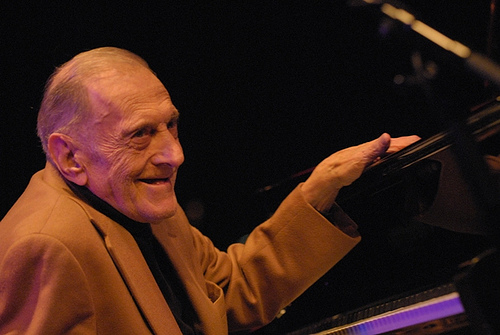
Afgelopen donderdag 14 december overleed Frank Morgan aan de gevolgen van kanker in zijn woonplaats Minneapolis. Hij was juist terug van een succesvolle Europese tournee. De legendarische altsaxofonist (1933) heeft een dynamisch leven achter de rug en verdween door 'personal problems' (een eufemisme voor drugsproblemen) het grootste deel van de periode 1955-1985 van de jazzscene. Aanstaande zaterdag zal er in Taos, New Mexico een herdenkingsbijeenkomst worden gehouden. Op die dag, 23 december, zou Morgan zijn 74ste verjaardag hebben gevierd.


Onze medewerker Eddy Determeyer schreef een mooie, persoonlijke necrologie, die je hier kunt lezen:

Het betere leven van Frank Morgan

"It's great to be alive," mompelde Frank Morgan in de microfoon. Toen stond hij op en slofte gebogen en nietig naar achter, waar het podium duister was.
Zo eindigde mijn recensie van het concert dat altsaxofonist Frank Morgan op 1 november jl. in het Groninger popcentrum De Oosterpoort gaf. Na afloop van zijn Europese tournee met het trio van pianist Rein de Graaff werd darmkanker bij de saxofonist geconstateerd. Kort daarna, op 14 december, overleed hij in zijn woonplaats Minneapolis. Hij werd 73.


door Eddy Determeyer, december 2007

Nee, hij voelde zich prima, had hij me in de kleedkamer nog toegevoegd. Tja, die rechterhand en dat rechterbeen werden er door de jaren niet beter op. En hij had last van evenwichtstoornissen, wat hem onzeker maakte bij het traplopen. Maar was dat niet zijn eigen schuld? Had hij na die beroerte niet gebeden of hij alstublieft weer saxofoon mocht spelen? "Dan zou ik een manke poot of zo voor lief nemen." Hij antwoordde me niet, ik kreeg geen ja of nee te horen. "Maar moet je nu zien: ik loop mank, maar ik spéél." Dat vertrouwde hij me tijdens een interview in 2003 toe.

Hij woonde weer bij familie in zijn geboorteplaats Minneapolis, zei hij in De Oosterpoort. Dan ga je zeker met Prince spelen, grapte ik, die heeft een zwak voor goeie saxofonisten. Nou nee – hij dacht er eerder over naar Nederland te verhuizen. De liberale, verlichte sfeer hier, ook ten aanzien van drugs, beviel hem wel. Kijk maar uit voor de Nederlandse skunk, waarschuwde ik hem, dat is heel wat anders dan die muzikantenwiet van jullie daar. Om er serieuzer aan toe te voegen dat collega's van hem Nederland wel gebruiken om van daaruit op het hele continent te kunnen werken.

De laatste 22 jaar van zijn leven was Morgan weer een vrij man, na alles bij elkaar 28 jaar in de nor. De saxofonist was wat je noemt een draaideurcrimineel. Als hij vrij was ging het een tijdje goed, vervolgens ging hij weer aan de coke en de smack, liet de muziek de muziek en belandde in de bajes. Vervolgens werd hij op een gegeven moment weer vrijgelaten, waarna het circus opnieuw begon. Hij zag Chino aan de binnenkant, Tchachapi, San Quentin (twee maal), San Luis Obisbo, Synanon. "San Quentin was geen leuke plek om te zijn. Maar er zaten vijfduizend man op een klein oppervlak bijeen en ik heb dus veel mensen zitten observeren. Echt verbazingwekkend: wanneer je mensen als Charlie Manson ontmoet, een heel aardig gastje. In die periode ben ik volwassen geworden."

Hij leerde er ook schaken en deed mee aan interpenitentiaire toernooien. En hij kwam collega-altist Art Pepper in de nor tegen, naast Charlie Parker een grote invloed op zijn eigen stijl. In Amerikaanse gevangenissen zitten altijd ruimschoots voldoende goeie muzikanten om er een puike bigband te kunnen formeren.

De muziek kreeg Frank met de spreekwoordelijke paplepel ingegoten. Zijn vader Stanley Morgan was gitarist in het orkest van saxofonist Harlan Leonard. "Van mijn vader heb ik gehoord dat hij wel naast mijn wiegje zat te oefenen. Daar werd ik dan rustig van. Hij vertelde ook altijd dat ik die gitaar wilde vasthouden." Toen hij drie was had hij een eigen gitaartje. Vier jaar later nam pa hem mee naar een optreden van de bigband van pianist Jay McShann. "Toen Bird opstond om zijn eerste solo te spelen keek ik mijn vader aan en zei: 'Het is wel mooi geweest met die gitaar, maar nu wil ik zó'n ding daar'." Senior nam hem in de pauze mee naar de kleedkamer, om mijnheer Bird een handje te geven. Stanley Morgan en Charlie Parker kenden elkaar van de Rockets van Harlan Leonard, waar Parker een blauwe maandag in had gespeeld.

Op zijn vijftiende won Frank een talentenjacht, de eerste prijs was een – kortstondig – contract bij vibrafonist Lionel Hampton. 'Little Bird' werd hij wel genoemd. Frank Morgan was een van de vele kleine Birds in die dagen.

En juist toen de toekomst hem aan het eind van een stralend, met rozenblaadjes bestrooid pad toe leek te lachen sloeg het noodlot toe. Een tournee met vocaliste Dinah Washington moest halverwege worden afgebroken: geelzucht, vanwege vuile naalden. De eerste veroordeling volgde op zijn negentiende, net toen hij met Max Roach en Clifford Brown zou gaan toeren. Sindsdien zijn er lange perioden geweest dat iedereen dacht dat hij dood was. In 1984 sloeg de gevangenispoort voor de laatste keer achter hem dicht en niet lang daarna trad hij voor het eerst van zijn leven in New York op. Volle zalen en rijen fans tot om de hoek. Sindsdien maakte Morgan een vijftiental platen met onversneden bop.

De attaque had uiteraard invloed op zijn welsprekendheid op de alt. Maar net als bij pianist Oscar Peterson leek zijn zeggingskracht, zijn soul, er alleen maar bij te hebben gewonnen. Na de exuberante bebop-watervallen voer hij nu op een wijze, brede rivier. Het hectische leven met heroïne en politiegezeik was definitief verleden tijd. "Het verschil met vroeger is dat wat ze ook doen, het mij niet meer zal raken. Ik heb nu een beter leven."


Foto: Frank Morgan en Rein de Graaff op 31 januari 2003 in De Tor in Enschede

Bron: http://www.draaiomjeoren.com/

13 augustus 2007

Requiem


Sal Mosca, jazz pianist, father, brother, teacher, and friend, passed away Saturday, July 28, 2007, in White Plains, New York. He was 80 years old.

Sal enjoyed a nearly seven decade career of improvisational jazz piano that touched the lives of many people. Perhaps more so than his music, Sal's values for living affected everyone who knew him. Those who knew Sal only from appreciation of his music surely were able to glean the depth of his commitment to purity and the integrity he brought to everything he produced.

Sal was, and will remain, a teacher in every sense of the word. The philosophy he articulated and lived was one of simple and complete dedication to the spirit of creation undiluted by external influence. Sal rejected commercialism, populism, consumerism, and the faddish. In their place, he maintained and nurtured the values of thrift, independence, freedom, self improvement and self exploration. Most of all, Sal believed in generosity. Sal gave everything away: his thoughts, his time, his values, his music.

While Sal may have been viewed by some as iconoclastic, in reality he was a rock of tradition that, by remaining true to quality, threatened the evolving status quo. By this, Sal demonstrated his courage in the face of enormous forces urging compromise and conformity.

Sal is survived by his three children and seven grandchildren. He is also survived by the thousands of souls whose lives he touched with his words and his music.

Gratefully, Sal was able to record a body of incredible music during his lifetime that will live on as ethereal vibrations that will inspire, soothe, and amaze us for the years and generations to come. Life is fragile; art perseveres.

"Music is your own experience, your own thoughts, your wisdom. If you don't live it, it won't come out of your horn. They teach you there's a boundary line to music. But, man, there's no boundary line to art."
Charlie Parker

"Your Requiem is finished. It has made me sad, for I sang it with all my heart."
Franz Schubert

03 augustus 2007

21 juli 2007

Zoot Sims - My Old Flame

Weergaloze techniek en sound...!

21 april 2007

Tribute to Michael Brecker (1949-2007)

By Pat Metheny

Here is the text of Pat Metheny’s talk at the memorial service held for Michael in New York’s Town Hall, February 20, 2007. Also speaking and/or performing were Sam Brecker, Jessica Brecker, Susan Brecker, Randy Brecker (w/Joey Calderazzo, James Genus & Jeff "Tain" Watts, David Liebman, Darryl Pitt, James Taylor, Herbie Hancock (w/John Patitucci & Jack DeJohnette) and Paul Simon. The event was a celebration of Michael Brecker’s amazing life. More than 1600 people were in attendence.

The cure for many life-threatening blood diseases such as lymphoma, leukemia and MDS already exists - it's us. Raising funds to pay for the testing of more donors is crucial. Time is of the Essence, a fund created in Michael's honor, will help make this possible. 100% of all donations are used for testing new donor registrants. Please-make a tax deductible donation today. Call 1-800-627-7692 or go to www.themarrowfoundation.org.

Here are Pat’s comments:

The piece I just played was written many years ago, especially for Mike. We played it together lots of times.

It was called Every Day (I Thank You).

Somehow those words have an extra special meaning today.

We all have so much to thank Mike for.

Music was, of course, what gave me, and probably many of us here today, the chance to know Mike, through music. In my case, first as an admirer and then as a collaborator.

I have often mentioned that the most treacherous location in the jazz world was to be on a bandstand as the guy who has to play the solo right after Mike Brecker.

I was lucky to have been in that situation many times over the years, and I learned so much from Mike on so many levels, as all of us who ever had the good fortune to play with him always did.


There’s been, from the very earliest days, so much to talk about Mike, the musician.


There's just the whole thing about the way he played. It was just so amazing to hear somebody play like that. Every single time.

For musicians, there are hundreds of nuts and bolts things going on there to marvel at, to study, to learn from, to enjoy. Things that have literally set the bar for all of us in so many areas over the past 35 years, as they will for future musicians for countless generations to come.

In many ways, I think at various points everyone was so blinded by the brilliance and ingenuity and strength of this guy, coming along with perfect time, who had found another 150,000 ways to navigate through any given set of chord changes while simultaneously displaying a level of saxophone technique and a sound that seemed almost superhuman.

So many things in action there in fact, that the deepest treasure of Mike’s amazing gift was sometimes hard to pick out in the wealth of all of it.
Because even with all of that, the real thing that made Mike so special as a musician, as a player, was his incredible ability to communicate what it is to be human. The complications of it. The struggle of it. The joy of it. To manifest a sound that could describe things about what it is to be here on earth that everyone, musician or not, could feel and recognize as being true.

That is the rarest thing.


His communicative skills were evolved far beyond any particulars of any given style of music, or the advanced level of technique that he possessed, or the assimilation of his influences, or even music itself, as it turns out.

Because the thing underneath it all was this;

Mike had a way of connecting with people in every important human transaction, that was kind of the fundamental currency that in turn gave his playing and his music the illuminating quality that made him stand so apart.

In retrospect, the diligence that he applied towards music was simply a symptom of the transcendent quality to touch people deeply that was pervasive in so many aspects of his life.


I know that for me, my interactions with Mike over the years all retain an almost indelible quality in my memory that is very unique. From the smallest moments, to the biggest concerts, somehow I remember everything about being around him in such detail.


In the past several years, during his fight, and in particular in the weeks since his passing, the outpouring of love for Mike has been so bountiful, so beautiful.

It’s notable how in almost every description of an encounter with Mike, no matter who is talking, you can feel the person reflecting on those minutes, or hours or months or years that they were around him as being among the best moments of their lives.

Mike really paid attention. And in his quiet and gentle way, he noticed and appreciated all the things that make each one of us around him exactly who we are. It seems that he had that gift with just about everyone he encountered. And as musicians, he saw and brought out the best in all of us. Musically, and maybe more importantly, in every other way too.


The timelessness and weight of Mike’s contribution may ultimately be traced in equal measure to the humility that he naturally and effortlessly carried with him at all times. Mike’s ability to make every person in every room feel like a valuable and genuine peer - especially given the incredible skills and accomplishments that he himself possessed - really put him in category entirely of his own.


Last summer, Mike was well enough to finish a new album. By that time, his fight had been an ongoing battle for more than two years and Mike had not been able to physically play for most of that time.

What happened in the studio during those few days in August is almost impossible to describe. It’s one of the most amazing, powerful, unbelievable things that I, and all of us who were there, have ever seen, or ever will see.

We just finished mixing and mastering the record a couple days ago and in a little while here you will hear a brief fragment of it. You’ll hear right away what I’m talking about.

Mike just left us some of the greatest music of his career. Of his life. And his efforts to get this final message out to all of us - which is really what it was - a message - will go down as one of the great codas in modern music history.

It is said that the best way to honor someone who has left us is to try to emulate their best qualities in the way that we live the remainder of our own days.

May that start here with all of us today.

We’ll never have a better model than Mike about what it is to be here on earth, and how to live our lives.

Along with Susan, Jess and Sam, Mike is a hero for all of us.

Francis Wolff

Via deze link een film over de beroemde foto's van Francis Wolff tijdens The Blue Note Sessions.

19 april 2007

GéVéDé

Dat was de vloek die ik op donderdag 29 maart om 22.48 uur precies hardop uitte. Ik was weer eens dom geweest. In de auto had ik noch Radio 1 aanstaan - sport not my cup of tea - noch de BNR-herhaling van een stand-up comedian die luisterde naar de naam Bush en ook had ik geen cd in het daartoe bestemde sleufje geduwd. Ik stemde af op Arrow Jazz en viel midden in een solo van Dexter. Bijna had ik mij verzoend met het bestaan van deze zender met het achtervoegsel jazz.

door Herbert Noord, april 2007

Overdag moet je zeker niet afstemmen op dit station, want wat bij die radio onder de noemer jazz wordt gebracht brengt mij niet in een opperbeste stemming. Zeurzangers en zeurzangeressen voeren absoluut de boventoon, Nora Jones en consorten. Dat werk.

's Avonds na negenen scheen het jazzgehalte toe te nemen en viel er af en toe echte jazz te beluisteren. En het moet gezegd: ook mijn muziek wordt er volgens de Buma-afrekeningen wel gedraaid. Bravo, een pluspunt en reden om af en toe die zender weer eens op te zoeken.

Na Dexter hoorde ik een zangeres met Gilberto-trekjes zonder dat het Astrud was, wellicht haar zingende nichtje. Daarna kwam iets onduidelijks en vervolgens betrad Billie Holiday de ether met 'Don’t Explain'. Toen vloekte ik. Eén of andere ongelofelijke hufter had een drummachine door dit mooie nummer gemixt. Er is werkelijk niets meer heilig in deze wereld. Hoe haal je het in je bolle kop een prachtig nummer op deze manier te verkwanselen, aan te randen, te verkrachten. God, wat was ik kwaad.

De website van Arrow jazz opgesnord om te kijken wie er verantwoordelijk was voor deze misdaad. Welke non-valeur van een dj dit nu weer op zijn geweten heeft. Het moest wel een dj zijn, want volgens mij is er geen echte muzikant in de wereld te vinden die zijn naam aan zoiets leent. Dat was niet eenvoudig te achterhalen, maar wat ik als beschamend staaltje van verkrachting had gehoord, wordt onder de noemer 'Angel-mix' op cd verkocht. Er zit dus een gigantische a-muzikale klojo muziek te verpesten om daar een stevige boterham aan te verdienen. Een 'Hell’s Angel', dat is wel duidelijk. En niet één nummer, nee, cd's vol.

Is er iets aan te doen? Is deze gangbang te stuiten? Is deze tomeloze cultuurbarbarij nog in te dammen? Nee, daarvoor is het te laat en ontbreekt ook maar enige wetgeving. Eigenlijk is het gelijk aan het afdrukken van de Nachtwacht op koektrommeltjes en het vernoemen van een vodka naar van Gogh. 'Alles van waarde is weerloos', zei Lucebert en hoe gelijk had hij.

Bron: http://www.draaiomjeoren.com/

Hammond-organist Herbert Noord (26 juli 1943) formeerde in 1967 zijn eerste eigen groep met onder meer Hans Dulfer. In 1969 bracht hij met deze groep het debuutalbum 'Live At The Bohemia Jazza Club' uit. In de zeventiger jaren maakte Herbert platen met onder anderen Alan Laurillard, de Amerikaanse saxofonist Harvey Kaiser en de Amerikaanse gitarist Paul Weeden. Met Kaiser tourde Herbert diverse malen door de Verenigde Staten. In 1989 formeerde hij met tenorsaxofonist Rinus Groeneveld en drummer Pierre van der Linden de zeer succesvolle - en nog steeds actieve - formatie Advanced Warning. De band bracht verschillende cd's uit, speelde diverse keren op het North Sea Jazz Festival, tourde regelmatig door Duitsland en Zwitserland en was een graag geziene gast op de belangrijke podia en festivals in Nederland.